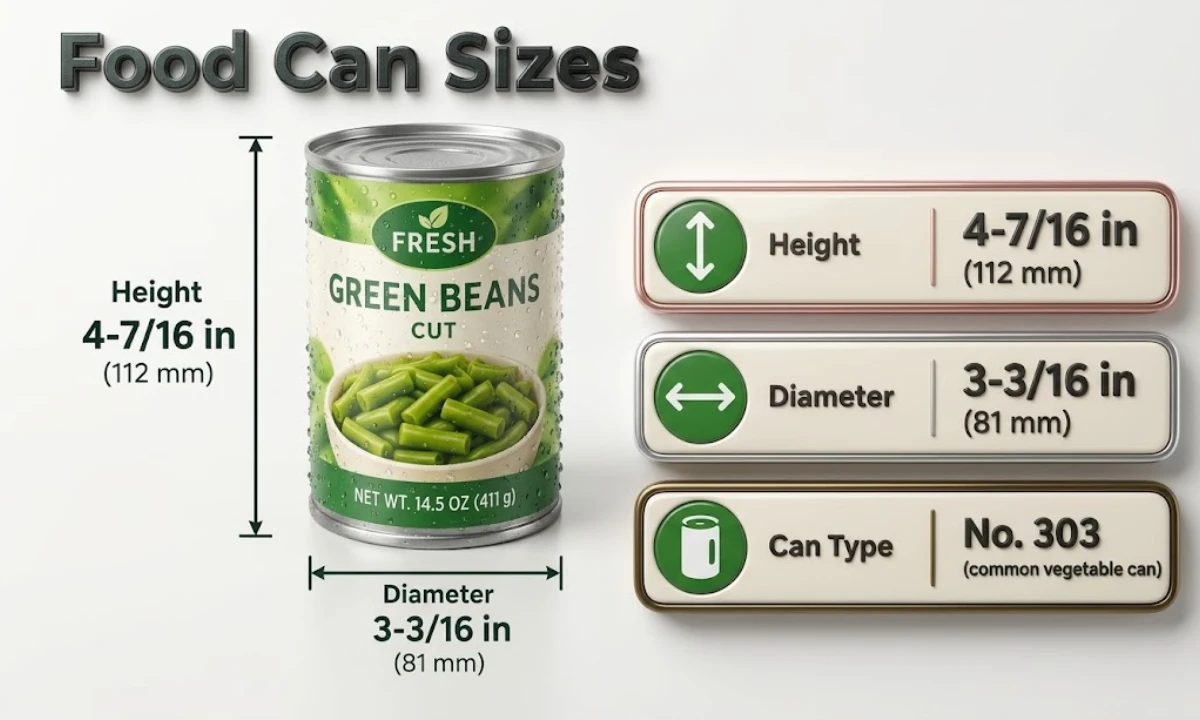
A standard No. 303 food can — the most common vegetable can in the US — measures 3-3/16 inches (81 mm) in diameter and 4-7/16 inches (112 mm) tall. It holds approximately 15 to 17 oz (2 cups).
This guide covers every standard can size, exact dimensions, volume, and how to read industry can codes used by Ball Corporation, Crown Holdings, and commercial food packers worldwide.
Food Can Sizes Chart
Every standard food can size with volume, weight, and cup measurement:
Can Size
Common Name
Approx. Volume
Approx. Net Weight
8 oz
Small
1 cup
8 oz
No. 1 (Picnic)
Small Vegetables / Soup
1¼ cups
10.5 – 12 oz
No. 300
Standard Small
1¾ cups
14 – 16 oz
No. 303
Most Common Vegetable
2 cups
15 – 17 oz
No. 2
Medium
2½ cups
20 oz
No. 2½
Large Fruit / Tomato
3½ cups
27 – 29 oz
No. 3 Cylinder
Juice / Institutional
5¾ cups
46 – 51 oz
No. 5
Large Quantity
7 cups
56 oz
No. 10
Institutional / Bulk
12 – 13 cups (3 qts)
102 – 117 oz (6.5 – 7.3 lbs)
The No. 303 is the most widely used food can in US retail — the standard size for canned vegetables, beans, soups, and fruit. When a recipe calls for “one can,” it almost always means a No. 303.
FOOD CAN
8 oz Can
Small
Volume1 cup
Net Weight8 oz
PICNIC CAN
No. 1 Can
Small Vegetables / Soup
Volume1¼ cups
Net Weight10.5–12 oz
FOOD CAN
No. 300 Can
Standard Small
Volume1¾ cups
Net Weight14–16 oz
VEGETABLE CAN
No. 303 Can
Most Common Vegetable Can
Volume2 cups
Net Weight15–17 oz
FOOD CAN
No. 2 Can
Medium
Volume2½ cups
Net Weight20 oz
FRUIT CAN
No. 2½ Can
Large Fruit / Tomato
Volume3½ cups
Net Weight27–29 oz
JUICE CAN
No. 3 Cylinder
Juice / Institutional
Volume5¾ cups
Net Weight46–51 oz
LARGE CAN
No. 5 Can
Large Quantity
Volume7 cups
Net Weight56 oz
BULK CAN
No. 10 Can
Institutional / Bulk
Volume12–13 cups (3 qts)
Net Weight102–117 oz (6.5–7.3 lbs)
Food Can Dimensions by Size
Can Code
Common Name
Diameter
Height
Volume
No. 6Z (211)
Small / Single-serve
2.02 in / 51 mm
2.6 – 3.5 in
6 oz (0.7 cups)
No. 1 Picnic (211)
Small Veg / Soup
2.6 – 2.8 in / 66–71 mm
4.0 – 4.9 in
10.5 – 12 oz
No. 300 (300×404)
Standard Small
~3.0 in / 76 mm
~4.4 in / 112 mm
14 – 16 oz
No. 303 (303×407)
Most Common Veg
3-3/16 in / 81 mm
4-7/16 in / 112 mm
15 – 17 oz
No. 2 (307×409)
Medium
~3.4 in / 86 mm
~4.6 in / 117 mm
20 oz
No. 2½ (401×411)
Large Fruit / Tomato
~4.1 in / 104 mm
~4.7 in / 119 mm
27 – 29 oz
No. 3 Cylinder
Juice / Institutional
~4.2 in / 107 mm
~7.0 in / 178 mm
46 – 51 oz
No. 5
Large Quantity
~5.1 in / 130 mm
~5.6 in / 142 mm
56 oz
No. 10 (603×700)
Institutional / Bulk
6-3/16 in / 157 mm
7.0 in / 178 mm
102 – 117 oz
How to Read Food Can Dimension Codes
The industry can code system looks confusing at first — but the logic is simple once you know the formula.
Every can code is expressed as two 3-digit numbers separated by a × symbol — for example, 303 × 407.
First number = diameter in whole inches and sixteenths
Second number = height in whole inches and sixteenths
How to decode it:
The first digit = whole inches
The last two digits = sixteenths of an inch
So 303 means 3 inches + 3/16 inch = 3.1875 inches. And 407 means 4 inches + 7/16 inch = 4.4375 inches.
Code
Calculation
Actual Measurement
303
3 + 3/16 in
3.1875 in (81 mm)
407
4 + 7/16 in
4.4375 in (113 mm)
603
6 + 3/16 in
6.1875 in (157 mm)
700
7 + 0/16 in
7.0 in (178 mm)
No. 303 Can — The Most Common Food Can
The No. 303 can is the standard for canned vegetables, beans, tomatoes, and fruit in US retail. Green Giant, Del Monte, Hunt’s, Bush’s, and virtually every major canned food brand uses this as their primary format.
Measurement
Imperial
Metric
Diameter
3-3/16 in
81 mm
Height
4-7/16 in
112 mm
Can Code
303 × 407
—
Volume
2 cups
~450 mL
Net Weight
15 – 17 oz
425 – 482 g
When a recipe says “one 15 oz can” of tomatoes or beans, it’s referring to a No. 303 can. Modern retail cans have shifted to labeled net weights rather than size numbers — but the physical container dimensions remain the same.
No. 10 Can — The Institutional Standard
The No. 10 can is the largest standard food can — used exclusively in restaurants, cafeterias, catering operations, food banks, and institutional kitchens. It’s rarely seen in retail grocery.
Measurement
Imperial
Metric
Diameter
6-3/16 in
157 mm
Height
7.0 in
178 mm
Can Code
603 × 700
—
Volume
12 – 13 cups (3 quarts)
~2.8 – 3.1 L
Net Weight
102 – 117 oz
6.5 – 7.3 lbs
At nearly 6.2 inches wide and 7 inches tall, the No. 10 can is a large-format container designed for high-volume food prep. A single No. 10 can of tomatoes holds the equivalent of 6 to 7 standard retail cans (No. 303).
The No. 10 can is used across the USDA commodity food program — supplying schools, food banks, and emergency relief operations with large-format canned goods. Its dimensions are standardized to fit commercial kitchen storage systems and institutional shelving.
Two-Piece vs. Three-Piece Food Cans
Not all food cans are built the same. The construction method affects strength, leak resistance, and what foods can be packed inside.
Three-Piece Cans
A cylindrical body with a welded or bonded side seam plus a top and bottom lid. The side seam is visible. These are versatile and used for solid foods — vegetables, fruits, soups, and meats. They allow more flexible sizing and are the most common construction in food service.
Two-Piece Cans
A single seamless body with an integrated bottom and one applied lid. No side seam — stronger against pressure and more leak-resistant. Two-piece cans subdivide into three types:
Type
Description
Common Products
Single-Drawn
Shallow, wide body
Tuna, sardines, small seafood
Drawn & Redrawn (DRD)
Deeper cylinder, pulled in stages
Meats, soups, ready meals
Drawn & Wall-Ironed (DWI)
Thinned, elongated sidewalls
Beverages, processed foods
Most aluminum beverage cans (beer, soda, energy drinks) are DWI two-piece cans — the same body-forming technology used in premium food packaging. The thin walls are what allow high-speed filling lines to run efficiently at industrial scale.
Numbered Can Sizes
Standard numbered can sizes map older recipe measurements to modern volume and weight equivalents. Many vintage and classic recipes reference these numbers — knowing what they mean prevents buying the wrong size.
Can Size Number
Approximate Volume
Approximate Weight
No. 1 (Picnic)
1¼ cups
10½ – 12 oz
No. 300
1¾ cups
14 – 16 oz
No. 303
2 cups
15 – 17 oz
No. 2
2½ cups
20 oz
No. 2½
3½ cups
27 – 29 oz
No. 3
5¾ cups
51 oz
No. 5
7 cups
56 oz
No. 10
3 quarts (12 – 13 cups)
6½ – 7 lbs 5 oz
Recipe conversion guide — old can numbers to modern retail sizes:
Recipe Calls For
Modern Retail Equivalent
Volume
No. 1 (Picnic) can
Small 10.5 – 12 oz can
1¼ cups
No. 303 can
Standard 15 – 16 oz can
2 cups
No. 2 can
20 oz can
2½ cups
No. 2½ can
28 oz can (large tomatoes)
3½ cups
No. 10 can
Institutional size (not retail)
3 quarts
8 oz can
Small single-serve can
1 cup
The No. 2½ can is the size behind standard 28 oz canned whole tomatoes — a staple in Italian-American cooking. When a pasta sauce recipe calls for a “large can of tomatoes,” it means a No. 2½.
The most common food can — the No. 303 — is 3-3/16 inches (81 mm) in diameter and 4-7/16 inches (112 mm) tall. It holds 2 cups (15–17 oz). The largest standard can, the No. 10, is 6-3/16 inches wide by 7 inches tall and holds 3 quarts.
What are the different sizes of cans?
Standard US food cans range from the 6 oz single-serve to the No. 10 institutional can (102–117 oz). The most common retail sizes are No. 303 (15–17 oz), No. 2 (20 oz), and No. 2½ (27–29 oz).
Is a can 8 or 12 oz?
It depends on the product. A standard food can is typically 14–17 oz (No. 303). An 8 oz can is a smaller single-serve food format. A 12 oz can is the standard for beverages like soda and beer — not typically used for canned food.
What are the different sizes of tin cans?
Standard tin can sizes range from No. 6Z (6 oz) through No. 10 (up to 117 oz). Common retail sizes include No. 303 (15–17 oz), No. 2 (20 oz), and No. 2½ (27–29 oz). Institutional kitchens primarily use the No. 10 can.
What two foods never expire?
Honey and pure salt are the two foods most widely recognized as having an indefinite shelf life when stored properly.
Can you eat 20-year-old frozen food?
Frozen food is technically safe to eat indefinitely if kept at 0°F (−18°C) or below — freezing stops bacterial growth entirely. The USDA recommends consuming most frozen foods within 1 to 2 years for best quality, even if they remain technically safe beyond that.
Hi, I’m Aria Blake, the author at FramesSize.com. I help make measurements simple with clear guides, easy explanations, and practical size comparisons. Explore our content to understand dimensions, frame sizes, lengths, and everyday measurements quickly and confidently.