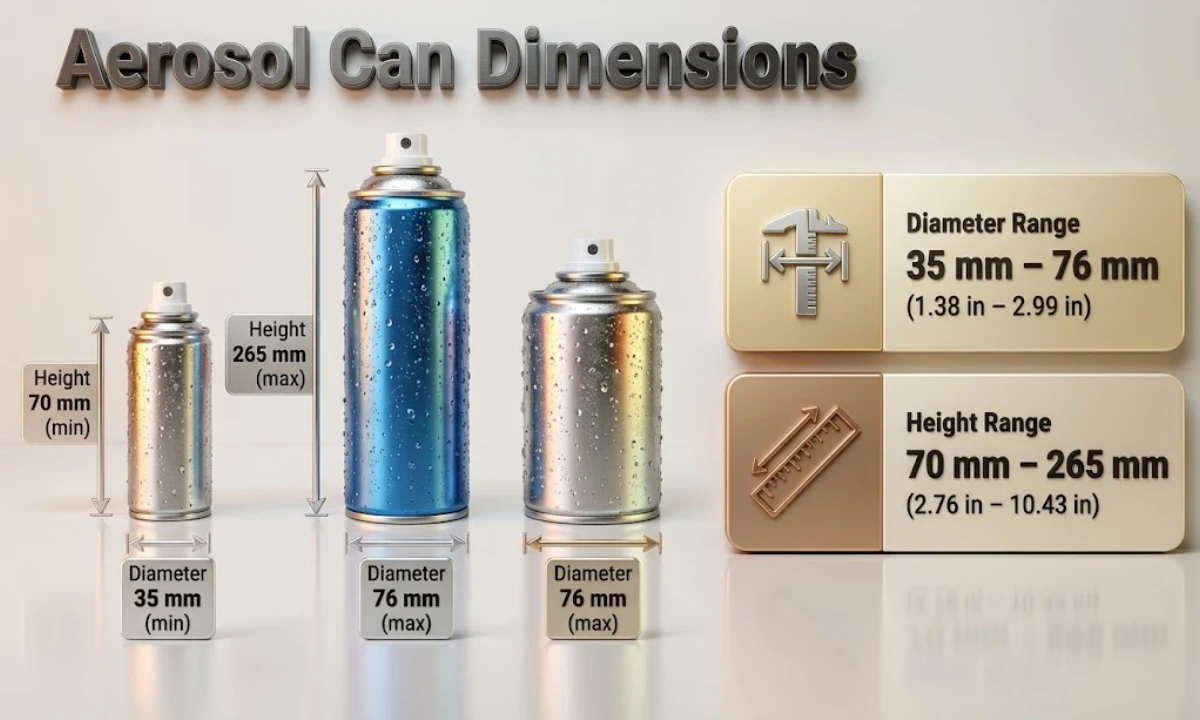
Standard aerosol cans range from 35 mm to 76 mm in diameter and 70 mm to 265 mm in height. Capacity runs from 15 ml travel vials to over 750 ml for large household and industrial formats.
The most common diameter worldwide is 65 mm — used for hairspray, spray paint, and household cleaners in the 400–750 ml range.
Standard Aerosol Can Diameters
Aerosol cans are sized by body diameter first — height and capacity vary within each diameter class:
Diameter
Industry Size Code
Common Use
Typical Capacity
45 mm
112
Travel sizes, compact air fresheners
50 – 150 ml
52 mm
202
Personal care, specialty sprays
228 – 290 ml
57 mm
205
Household and industrial sprays
300 – 375 ml
65 mm
211
Hair spray, paint, cleaners
400 – 750 ml
70 mm
214
Large household, automotive
500 – 800 ml
76 mm
—
Industrial / bulk format
600 – 887 ml
The 65 mm diameter is the global market standard for full-size consumer aerosols. Walk down any hairspray, spray paint, or household cleaner aisle — the majority of full-size cans are 65 mm wide.
MINI SPRAY
Mini / Travel
Diameter35–45 mm
Height70–130 mm
Capacity15–150 ml
Typical Use: Travel, samples, vials
SMALL SPRAY
Small
Diameter45–52 mm
Height100–150 mm
Capacity150–290 ml
Typical Use: Personal care, compact sprays
MEDIUM SPRAY
Medium
Diameter52–57 mm
Height130–185 mm
Capacity290–375 ml
Typical Use: Household, specialty products
STANDARD SPRAY
Standard / Full-Size
Diameter65 mm
Height150–220 mm
Capacity400–750 ml
Typical Use: Hair spray, paint, cleaner
INDUSTRIAL SPRAY
Large / Industrial
Diameter70–76 mm
Height200–265 mm
Capacity500–887 ml
Typical Use: Automotive, industrial products
Steel vs. Aluminum Aerosol Cans
Aerosol cans are made from two materials — each with different size ranges, design options, and manufacturing methods.
Steel (Tinplate) Aerosol Cans
Spec
Range
Diameters
45 mm, 52 mm, 57 mm, 60 mm, 65 mm, 70 mm
Capacity
~4 oz (118 ml) to 30 oz (887 ml)
Valve Opening
1 inch (25.4 mm) — universal standard
Construction
Three-piece (body + top + bottom)
Steel cans are the dominant format in household cleaners, automotive sprays, and industrial products — they withstand higher internal pressures and are more cost-effective at large scale.
Aluminum Aerosol Cans
Spec
Range
Diameters
22 mm, 25 mm, 28 mm, 35 mm, 38 mm, 40 mm, 45 mm, 50 mm, 53 mm, 59 mm, 65 mm, 76 mm
Capacity
15 ml to 750 ml
Valve Opening
1 inch (25.4 mm) — universal standard
Construction
Two-piece seamless extrusion
Aluminum cans offer a wider micro-size range — down to 22 mm diameter for specialty vials — and allow custom body shapes like waisted profiles, ovals, and bullet shapes. They’re common in premium cosmetics, pharmaceutical sprays, and deodorant where shelf aesthetics matter.
Aluminum aerosol cans are made by impact extrusion — a process that punches a slug of aluminum into a seamless one-piece body with no side seam. This makes them stronger per unit weight than three-piece steel cans and gives designers more freedom to shape the body.
Aerosol Can Dimensions by Diameter Class
Height and capacity vary within each diameter — here’s the full breakdown:
45 mm Diameter Cans
Height
Capacity
Common Product
70 – 100 mm
50 – 75 ml
Travel deodorant, sample sprays
100 – 130 mm
75 – 150 ml
Compact air freshener, travel hairspray
52 mm (202) Diameter Cans
Height
Capacity
Common Product
~130 mm (406)
228 – 290 ml
Personal care, specialty sprays
65 mm (211) Diameter Cans
Height
Capacity
Common Product
~130 mm
300 – 400 ml
Standard hairspray, spray paint
~185 mm
500 – 600 ml
Full-size paint, cleaner
~220 mm
650 – 750 ml
Large household spray
Can code dimensions like 211 × 406 use the same inches + sixteenths formula as food cans. 211 means 2 and 11/16 inches (about 68 mm), and 406 means 4 and 6/16 inches (about 112 mm). European aerosol sizing shifted to direct millimeter measurements — but older US industry specs still use this code format.
Aerosol Can Size Chart
Size
Diameter
Height Range
Capacity
Typical Use
Mini / Travel
35 – 45 mm
70 – 130 mm
15 – 150 ml
Travel, samples, vials
Small
45 – 52 mm
100 – 150 mm
150 – 290 ml
Personal care, compact sprays
Medium
52 – 57 mm
130 – 185 mm
290 – 375 ml
Household, specialty
Standard / Full-Size
65 mm
150 – 220 mm
400 – 750 ml
Hair spray, paint, cleaner
Large / Industrial
70 – 76 mm
200 – 265 mm
500 – 887 ml
Automotive, industrial
Aerosol Can Types
Two-Piece Cans (Aluminum)
A seamless extruded body with a single integrated base — the lid is the only separate piece. Stronger against internal pressure, lighter weight, and allows custom shapes. Used for deodorant, cosmetics, pharmaceutical sprays, and premium personal care.
Three-Piece Cans (Steel)
A cylindrical body with a welded side seam plus a separate top and bottom. The most versatile and widely produced format globally. Used for household cleaners, spray paint, automotive products, and food-grade aerosols (cooking spray, whipped cream).
TSA Rules for Aerosol Cans on Planes
Aerosol size directly determines what you can fly with — carry-on and checked baggage have different rules.
Bag Type
Size Allowed
Notes
Carry-On (TSA 3-1-1)
100 ml (3.4 oz) or less
Must fit in one quart-sized clear bag
Checked Baggage
Up to 500 ml / 18 oz per can
Subject to airline and DOT limits
Prohibited (Both)
Bear spray, pepper gel, toxic repellents
Banned on all commercial flights
The TSA 3-1-1 rule applies to all liquids, gels, and aerosols in carry-on bags — each container must be 3.4 oz (100 ml) or less, all containers must fit in one quart-sized bag, and one bag per passenger.
The 100 ml limit applies to the container size — not the amount remaining. A 200 ml aerosol that’s 90% empty still violates the carry-on rule. The container itself must be 100 ml or smaller.
How Much Does a 12 oz Spray Can Cover?
A 12 oz aerosol spray paint can covers approximately 6 to 8 square feet per coat on a smooth, non-porous surface — or 4 to 6 square feet on rough, porous, or textured surfaces.
Coverage varies significantly by:
Paint type — primers cover less than finish coats
Application technique — thin even passes vs. heavy wet coats
Surface porosity — raw wood absorbs significantly more than sealed metal
Color — dark colors over light backgrounds require more coats
Rust-Oleum, Krylon, and Montana all publish coverage estimates on their label — always check the specific product, not just the can size.
Standard aerosol cans range from 35 mm to 76 mm in diameter and 70 mm to 265 mm tall. The most common consumer size is 65 mm diameter for 400–750 ml products like hairspray and spray paint.
Can I bring a 2 oz aerosol on a plane?
Yes. A 2 oz (60 ml) aerosol is within the TSA 3-1-1 carry-on limit of 3.4 oz (100 ml). It must fit in a single quart-sized clear bag along with your other liquids and aerosols.
What are the different types of aerosol cans?
The two main types are two-piece aluminum cans (seamless, used for cosmetics and deodorant) and three-piece steel cans (welded side seam, used for paint, cleaners, and food aerosols). They differ in pressure resistance, design flexibility, and cost.
How much will a 12 oz spray can cover?
A 12 oz spray paint can covers approximately 6 to 8 square feet per coat on smooth surfaces — less on porous or textured materials. Coverage drops to 4 to 6 sq ft on rough wood or concrete.
What are the standard sizes of aerosol cans?
Standard aerosol diameters are 45 mm, 52 mm, 57 mm, 65 mm, 70 mm, and 76 mm. The 65 mm is the most common full-size consumer standard. All share a near-universal 1-inch (25.4 mm) valve opening.
What are the two types of aerosols?
The two main structural types are two-piece aluminum (seamless extruded body, used for premium personal care) and three-piece steel (welded body, used for household and industrial products).
Hi, I’m Aria Blake, the author at FramesSize.com. I help make measurements simple with clear guides, easy explanations, and practical size comparisons. Explore our content to understand dimensions, frame sizes, lengths, and everyday measurements quickly and confidently.