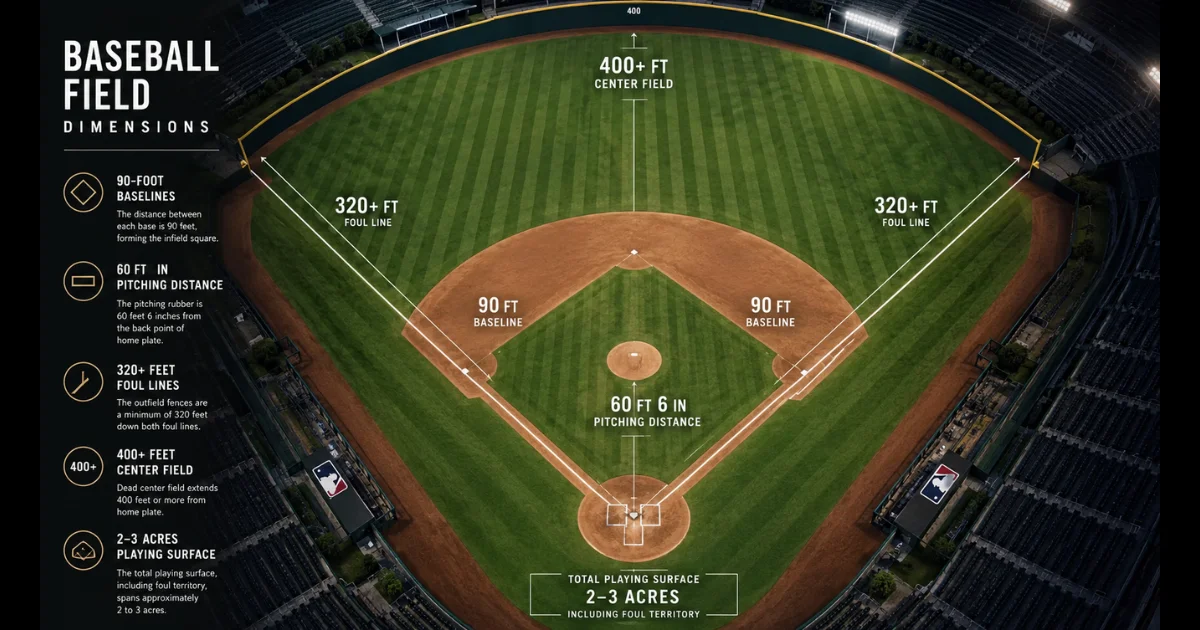
A standard MLB baseball field has 90-foot baselines forming the infield square, a pitching rubber set at 60 feet 6 inches from home plate, and outfield fences starting at a minimum of 320 feet down the foul lines and reaching 400+ feet to dead center.
Total playing area including foul territory varies by ballpark — most MLB stadiums span between 2 and 3 acres of playing surface.
What Are Baseball Field Dimensions?
The baseball diamond is one of the most precise playing surfaces in all of sports. Unlike football or soccer, where field size has minor flexibility, baseball’s infield dimensions follow strict rules down to the inch.
The infield is built around a 90-degree square — commonly called “the diamond” — with four bases at each corner.
core infield measurements:
Home Plate — A pentagonal rubber slab. Two sides measure 8.5 inches, three sides measure 12 inches. Width is 17 inches across the batter-facing edge.
Bases (First, Second, Third) — Each base is 18 inches × 18 inches at the MLB level. (MLB updated base sizes from 15 to 18 inches in 2023 to reduce collision injuries.)
Baselines / Base Paths — 90 feet between each base at the professional level.
Home to Second Base (diagonal) — 127 feet 3⅜ inches. This is the single most important verification measurement on any full-size diamond.
Pitching Rubber to Home Plate — 60 feet 6 inches. The rubber itself is a white slab measuring 24 inches × 6 inches.
Pitcher’s Mound — 18 feet in diameter, raised 10 inches above home plate level. The rubber sits 18 inches behind the mound’s center.
Batter’s Box — 4 ft × 6 ft at MLB, NCAA, and NFHS levels. Youth leagues use a narrower 3 ft × 6 ft box. The inside line sits 6 inches from the nearest edge of home plate.
Coaches’ Box — 15 ft × 35 ft, located outside the foul lines near first and third base.
On-Deck Circle — 5 feet in diameter, one on each side of home plate.
Running Lane — A 3-foot-wide lane, 45 feet long, running parallel to the foul line toward first base.
Standard Baseball Field Dimensions
Measurement
Professional (MLB)
Little League
Pinto/Tee Ball
Baseline
90 ft
60 ft
50 ft
Home to Second
127 ft 3⅜ in
84 ft 10¼ in
70 ft 8 in
Pitching Distance
60 ft 6 in
46 ft
38 ft
Batter’s Box
4 ft × 6 ft
3 ft × 6 ft
3 ft × 6 ft
Mound Height
10 inches
6 inches
4 inches
Baseball Outfield Dimensions
baseball-outfield-dimensions
At every level — including MLB — outfield fence distances vary from park to park. The only rules are minimum distance requirements.
At the MLB level, minimum outfield standards are:
Foul lines (left/right field): Minimum 320 feet from home plate
Center field: Typically 400 feet or deeper
Some of the most well-known outfield distances in MLB include:
Comerica Park (Detroit Tigers) — deepest center field in MLB at 420 feet
Fenway Park (Boston Red Sox) — shallowest center field at 390 feet; shallowest right field at 302 feet; but deepest left field wall (the famous Green Monster)
Wrigley Field (Chicago Cubs) — right field measures 353 feet
Oakland Coliseum — famous for the most expansive foul territory in MLB
Baseball Field Dimensions by Level
Every level of baseball uses a different baseline distance and pitching distance based on the age group and physical development of the players.
Full Dimensions Reference Table for All Levels
Level
Baseline
Home → 2B
Pitching Distance
CF Min.
LF/RF Min.
Mound Height
Skinned Infield Radius
Tee Ball
50 ft
70 ft 8 in
N/A
200 ft
125 ft
4 in
50 ft
Little League (Major)
60 ft
84 ft 10¼ in
46 ft
225 ft
175 ft
6 in
50 ft
Intermediate (50/70)
70 ft
99 ft
50 ft
275 ft
225 ft
6 in
65 ft
PONY League
80 ft
113 ft 2 in
54 ft
315 ft
265 ft
8 in
80 ft
Middle School (7th Grade)
70 ft
99 ft
50 ft
200 ft
200 ft
6 in
65 ft
Middle School (8th Grade)
80 ft
113 ft 2 in
54 ft
300 ft
250 ft
8 in
80 ft
High School (NFHS)
90 ft
127 ft 3⅜ in
60 ft 6 in
400 ft
300 ft
10 in
95 ft
NCAA (College)
90 ft
127 ft 3⅜ in
60 ft 6 in
400 ft
330 ft
10 in
95 ft
MLB (Professional)
90 ft
127 ft 3⅜ in
60 ft 6 in
400 ft+
320 ft
10 in
95 ft
Little League Baseball Divisions
Little League International organizes youth baseball across multiple age-based divisions, each with its own field size.
Division
Age Group
Baseline
Pitching Distance
CF Min.
LF/RF Min.
Tee Ball
4–7
50 ft
N/A
200 ft
125 ft
Minor League
5–12
60 ft (can reduce to 50 ft)
46 ft
200 ft
200 ft
Major League
9–12
60 ft (can reduce to 50 ft)
46 ft
200 ft
200 ft
Intermediate 50/70
11–13
70 ft (can reduce to 50 ft)
60 ft 6 in (can reduce to 50 ft)
200 ft
200 ft
Junior League
12–14
90 ft (can reduce to 75 ft)
60 ft 6 in (can reduce to 54 ft)
300 ft
300 ft
Senior League
13–16
90 ft
60 ft 6 in
300 ft
300 ft
PONY League Baseball Divisions
PONY Baseball (Protect Our Nation’s Youth) runs a parallel youth system with its own division structure.
League
Age Group
Baseline
Pitching Distance
CF Min.
LF/RF Min.
Foal
3–4
50 ft
38 ft
200 ft
125 ft
Shetland
5–6
50 ft
38 ft
200 ft
125 ft
Pinto
5–8
60 ft
38 ft
200 ft
125 ft
Mustang
7–10
60 ft
46 ft
225 ft
175 ft
Bronco
9–12
70 ft
50 ft
275 ft
225 ft
Pony
11–14
80 ft
54 ft
315 ft
265 ft
Colt
13–16
90 ft
60 ft 6 in
350 ft
300 ft
Palomino
15–19
90 ft
60 ft 6 in
350 ft
300 ft
Thorobred
17–23
90 ft
60 ft 6 in
350 ft
300 ft
Baseball Field Radius, Dugout & Home Plate Measurements
Baseline
Home Plate to Backstop
Base Cutout Radius
Home Plate Circle
Dugout Distance From Foul Line
90 ft
60 ft
13 ft
26 ft
15 ft
80 ft
40 ft
12 ft
24 ft
12 ft
70 ft
30 ft
11 ft
22 ft
9 ft
60 ft
25 ft
9 ft
18 ft
6 ft
50 ft
20 ft
9 ft
20 ft
6 ft
Baseball vs. Softball Field Dimensions
baseball-field-vs-softball-field-dimensions
Baseball and softball are not the same sport — and their fields are not the same size. Using a baseball template for a softball field creates real safety and gameplay problems.
No pitcher’s mound in softball. Pitching is delivered from a flat 16-foot-diameter circle. There is zero elevation change. This fundamentally changes how pitching speed and ball trajectory work.
Softball baselines are shorter — ranging from 55 ft to 65 ft depending on the division.
Softball outfield fences are closer — center field ranges from 175 ft (youth) to 315 ft (adult fastpitch).
The skinned infield in softball must extend at least 3 feet past the foul line before grass begins — a rule with no equivalent in baseball.
Backstop minimum is 25 ft for all softball divisions.
Softball Field Dimensions Table
Measurement
Field 1
Field 2
Field 3
Field 4
Baseline
65 ft
60 ft
60 ft
55 ft
Home to Second
91 ft 11 in
84 ft 10 in
84 ft 10 in
77 ft 9 in
Pitching Distance
50 ft
43 ft
40 ft
35 ft
Skinned Infield Radius
65 ft
60 ft
60 ft
55 ft
Backstop Min.
25 ft
25 ft
25 ft
25 ft
LF Distance
265 ft
190 ft
200 ft
150 ft
CF Distance
315 ft
220 ft
250 ft (adult)
175 ft
Fastpitch softball uses the deeper outfield distances (e.g., 200–250 ft). Slowpitch softball distances can vary by local league rules.
A standard MLB baseball field has 90-foot baselines forming the infield square, a pitching rubber set at 60 feet 6 inches from home plate, and outfield fences starting at a minimum of 320 feet down the foul lines and reaching 400+ feet to dead center.
What is the distance between bases in baseball?
The distance between adjacent bases matches the baseline length for that league. At MLB, NCAA, and high school levels it is 90 feet. It scales down to 80 ft (PONY),70 ft (Bronco),60 ft (Little League), and 50 ft (Pinto/Tee Ball).
How far is the pitcher’s mound from home plate?
At the professional, college, and high school level, the pitching rubber sits exactly 60 feet 6 inches from the back of home plate. This distance scales down to 54 ft (PONY Pony League),50 ft (Bronco),46 ft (Little League Major), and 38 ft (PONY Pinto and younger).
What are the baseball field dimensions for Little League?
A standard Little League Major Division field uses 60-foot baselines, a 46-foot pitching distance, and a home-to-second diagonal of 84 feet 10¼ inches. Outfield minimums are 225 feet to center field and 175 feet down the foul lines.
How much land do you need to build a baseball field?
A full professional or adult baseball field — including foul territory, backstop area, and safety zones — requires approximately 12,000 to 16,000 square meters (roughly 3 to 4 acres). A Little League or youth field can be built on 5,000 to 7,000 square meters (1.2 to 1.7 acres).
Hi, I’m Aria Blake, the author at FramesSize.com. I help make measurements simple with clear guides, easy explanations, and practical size comparisons. Explore our content to understand dimensions, frame sizes, lengths, and everyday measurements quickly and confidently.