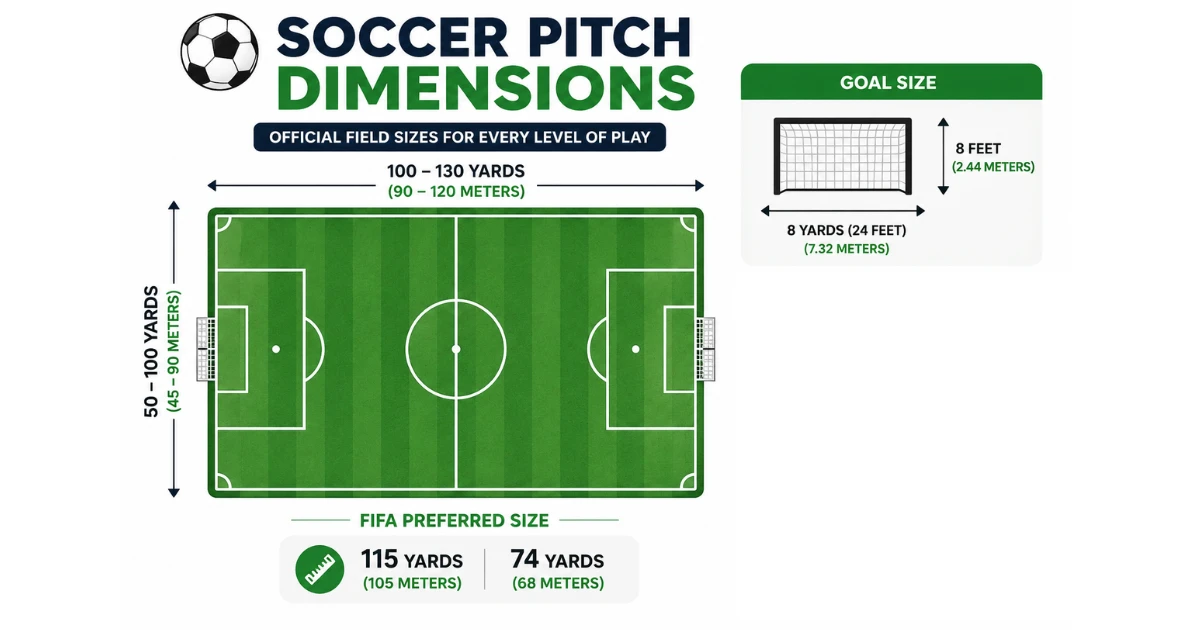
A standard professional soccer field measures between 100 to 130 yards long and 50 to 100 yards wide. For FIFA international matches, the requirements tighten to 110–120 yards long by 70–80 yards wide. The goal is always 8 feet high by 8 yards (24 feet) wide — universally consistent at every level.
Field size varies by competition level, age group, and governing body. This guide covers every official soccer pitch dimension — from FIFA and Premier League standards down to youth formats.
Soccer Field Dimensions by Level of Play
No two soccer fields are identical — but all must fall within the bounds set by their governing body. Here’s the full breakdown:
FIFA’s preferred field size of 105 × 68 meters (115 × 74 yards) is the gold standard used at the FIFA World Cup and across the UEFA Champions League. It’s the closest thing to a universal professional pitch.
No two professional stadiums have exactly the same pitch size. Old Trafford (Manchester United) runs a noticeably longer pitch than Stamford Bridge (Chelsea) — both are legal under FIFA guidelines, but the size difference directly affects how each team sets up tactically. Longer pitches favor possession and wide play; narrower pitches compress space and suit pressing systems.
Soccer Pitch Markings and Line Dimensions
The penalty area (the “18-yard box”) is the rectangular zone where the goalkeeper can handle the ball and where fouls result in penalty kicks. It extends 18 yards from each post and 18 yards deep from the goal line.
The goal area (the “6-yard box”) sits inside the penalty area and is used to determine where goal kicks are placed. All goal kicks can be taken from anywhere along the 6-yard line.
All line markings are part of the area they border. A ball landing on the touchline is in play. A ball landing on the goal line is a goal. A foul committed on the penalty area line — not inside it — does not result in a penalty kick. These distinctions matter in competitive play and are frequently misunderstood.
Youth Soccer Field Dimensions by Age Group
Youth soccer fields scale with player development. Smaller fields keep the game age-appropriate, increase player touches, and reduce physical demand on younger athletes.
U.S. Youth Soccer and US Club Soccer both follow these recommended age-group dimensions. The American Youth Soccer Organization (AYSO) uses the same framework with minor regional variations.
The transition from 9v9 to 11v11 at U14 is the most significant size jump in youth soccer development. Field length increases by roughly 30 yards, goal size becomes full adult regulation, and physical demands rise sharply. Coaches and facilities managers need to plan for this transition when designing multi-age soccer complexes.
Small-Sided Soccer Field Dimensions
Futsal — the FIFA-sanctioned indoor version of soccer — uses a hard court surface, a smaller low-bounce ball, and a significantly smaller field than outdoor soccer. It’s widely credited as one of the most effective development tools for technical skill, with players like Messi, Ronaldo, and Neymar all citing futsal as a major part of their early development.
Famous Soccer Stadium Pitch Dimensions
Professional clubs are not required to use the same pitch size — only to stay within FIFA’s allowable range. Here’s how some of the world’s most famous pitches compare:
All of these fall within FIFA’s legal international match range. The difference between the largest and smallest is only a few yards — but at elite level, even small pitch size changes are factored into match preparation.
Soccer Goal Dimensions

Goal dimensions are the one measurement that never changes at full adult level — regardless of field size, competition level, or governing body.
FIFA, UEFA, CONCACAF, MLS, NCAA, and NFHS all use the exact same adult goal size. The crossbar and posts must be white and cannot exceed 5 inches (12 cm) in diameter — circular or square profile both permitted.
The net is not required to have a specific depth by law — but FIFA recommends a minimum 1.5m depth to clearly show when a goal is scored and prevent balls from rebounding out deceptively. At top-level professional matches, deeper nets are increasingly standard.
Soccer Pitch Dimensions Size Chart
More Post: Standard Bathtub Dimensions
(Questions)
What are the dimensions of a soccer field in feet?
A professional soccer field ranges from 300 to 390 feet long and 150 to 300 feet wide. For FIFA international matches, the range narrows to 330–360 feet long and 210–240 feet wide. The FIFA preferred size is 345 feet long by 222 feet wide (105 × 68 meters). The goal is always 24 feet wide by 8 feet tall.
How big is a soccer field compared to a football field?
A standard NFL football field is 360 feet long by 160 feet wide (including end zones). A FIFA preferred soccer pitch is 345 feet long by 222 feet wide. The soccer pitch is slightly shorter but considerably wider — giving soccer players significantly more lateral space per position than American football.
What is the size of a soccer field for youth players?
Youth soccer field size depends on age group and player count. A U8 (4v4) field is approximately 25–35 yards long by 20–30 yards wide. A U10 (7v7) field runs 55–65 yards long. By U14, players move to the full 11v11 format on a field 100–110 yards long — close to full adult size.
How big is a FIFA World Cup soccer field?
FIFA World Cup pitches follow the international standard: 110–120 yards long by 70–80 yards wide (100–110 m × 64–75 m). The most commonly used World Cup dimension is 105 × 68 meters (115 × 74 yards) — FIFA’s official preferred size, used at the majority of World Cup venues.
What is the difference between a soccer field and a soccer pitch?
There is no difference — “soccer field” and “soccer pitch” refer to exactly the same playing surface. “Pitch” is the British and international term; “field” is predominantly used in the United States. Both describe the rectangular grass or artificial turf surface on which soccer is played, with identical dimensions and markings.

Hi, I’m Aria Blake, the author at FramesSize.com. I help make measurements simple with clear guides, easy explanations, and practical size comparisons. Explore our content to understand dimensions, frame sizes, lengths, and everyday measurements quickly and confidently.