A standard NBA basketball court measures 94 feet long by 50 feet wide. The rim height is set at 10 feet across every level — from youth leagues to the pros. But court size, key width, and three-point distance all change depending on whether you’re playing in the NBA, NCAA, FIBA, or high school.
This guide covers every official basketball court dimension — plus what most other guides completely miss.
Basketball Court Dimensions by Level of Play
Not all basketball courts are the same size. The court grows as the level of competition rises.
As competition level increases, the court gets longer and the three-point line moves further from the basket. This directly shapes how players shoot, drive, and defend.
Youth court sizes matter just as much. A 4th–5th grade court runs 74ft × 50ft, while 2nd–3rd grade courts scale down to 50ft × 42ft — keeping the game appropriately sized for young players still developing their skills.
Basketball Half Court Dimensions
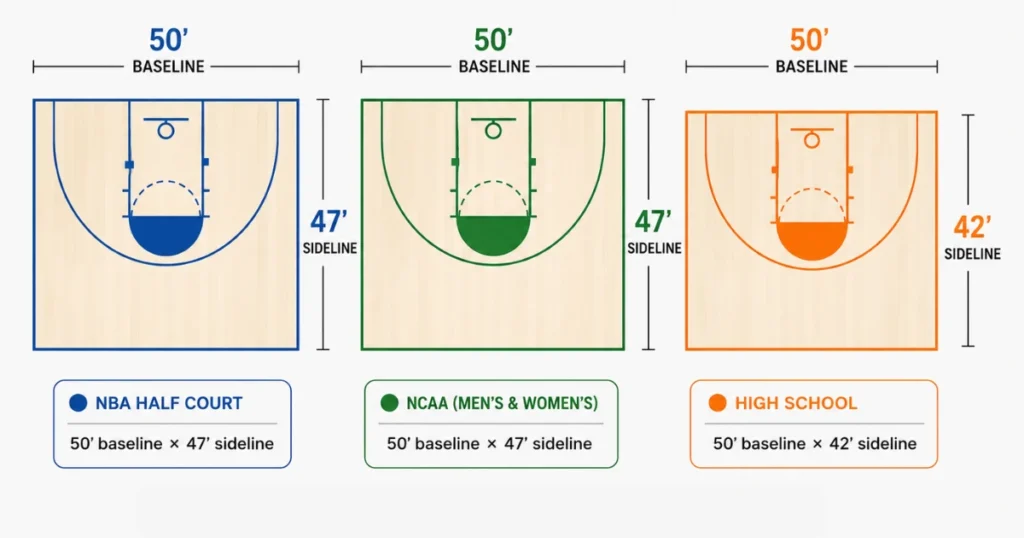
A half court covers one end of the full court. It’s used for backyard builds, pickup games, and skill training.
The NBA half court measures 50 feet (baseline) × 47 feet (sideline). College half courts match this exactly. High school drops to 50 feet × 42 feet.
Official Half Court Sizes:
- NBA Half Court — 50′ baseline × 47′ sideline
- NCAA (Men’s & Women’s) — 50′ × 47′
- High School — 50′ baseline × 42′ sideline
For backyard half courts, there’s no single required size. The most popular backyard build is 30′ × 30′ — enough room to shoot from behind the three-point arc without overspending. Smaller setups start at 20′ × 24′, and larger custom courts can stretch to 46′ × 78′ for near-regulation play.
Your backboard overhang distance affects how usable your half court actually is. Official courts use a 4-foot overhang at all levels. For a 20’×24′ backyard court, a 2-foot overhang is the practical standard. The larger your overhang, the more stopping room players have after driving to the basket — which directly reduces injury risk. Pole padding is always recommended, regardless of overhang size.
Basketball Court Lines, Zones and Markings Explained
Every marking on a basketball court exists for a reason. Knowing what each line means helps players, coaches, and court builders get it right.
Sidelines and Baselines
The sidelines run the full length of the court. The baselines (also called endlines) stretch behind each basket. Together they form the complete out-of-bounds boundary.
On an NBA court, sidelines run 94 feet and baselines run 50 feet.
The Key, The Paint and Free Throw Lane
“The key,” “the paint,” and “the lane” are all names for the same rectangular zone beneath each basket.
It stretches from the baseline to the free throw line. The NBA key is 16 feet wide. College and high school keys are 12 feet wide. Both sit 19 feet deep from baseline to free throw line, including the 4-foot backboard overhang.
Why the width difference matters: In the NBA, a defender cannot stand idle in the key for more than 3 consecutive seconds. The NCAA and FIBA do not enforce this the same way — defenders can float in the paint more freely. The wider NBA key creates more space and forces more active defense.
Free Throw Line Distance
The free throw line sits 15 feet from the front face of the backboard at every level — NBA, NCAA, FIBA, and high school. No exceptions.
The baseline to free throw line distance is 18 feet 10 inches, which factors in the standard 4-foot backboard overhang.
Three-Point Line Distance by Level
The three-point arc is one of the most talked-about measurements in basketball — and it varies more than most people realize:
- NBA — 23′ 9″ at the top; 22′ at the corners
- NCAA Men’s — 22′ 1.75″ (moved back for the 2020–21 season to align with international play)
- NCAA Women’s — 20′ 9″
- FIBA / Olympic — 22.15′ (6.75m)
- High School (NFHS) — 19′ 9″
All measurements go from the center of the rim to the outside edge of the arc line.
Center Circle and Half-Court Line
The center circle sits at midcourt and is where the tip-off jump ball happens at the start of every game.
NBA and NCAA circles have a 12-foot diameter (3.66m). FIBA uses a slightly tighter 11-foot 10-inch (3.60m) circle. The half-court line splits the court in two and enforces the backcourt violation — once a team crosses it, they cannot legally return with the ball.
No-Charge Arc and Restricted Area
The no-charge arc — also called the restricted area — is the small curved line painted directly under each basket.
The NBA added it in 1997 to prevent defenders from drawing charging fouls simply by standing beneath the hoop. Any contact that occurs inside this arc cannot be ruled an offensive charge.
On NBA courts, the arc has a 4-foot radius (1.22m). FIBA uses 4 feet 1 inch (1.25m). NCAA men’s courts use the same 4-foot radius. NCAA women’s courts do not include a restricted arc at all.
Basketball Hoop and Backboard Dimensions
Rim Height and Basket Dimensions
The rim sits exactly 10 feet above the floor at every competitive level. This has been the universal standard since basketball was invented.
The rim diameter is 18 inches (45.72cm) — wide enough to fit two basketballs side by side. The basket is placed 4 feet inward from the baseline.
Backboard Size and Standard Measurements
A regulation backboard measures 72 inches wide by 42 inches tall (6ft × 3.5ft). The inner target rectangle is 24 inches wide by 18 inches tall.
Professional-level backboards are made from tempered glass for maximum rebound consistency and clear sightlines for fans.
Backboard Overhang Distance Explained
Backboard overhang is the distance from the baseline to the front face of the backboard. It’s one of the most overlooked specs when planning any court build.
The official overhang at all levels — NBA, NCAA, and high school — is 4 feet.
For backyard courts, this distance typically falls between 0 and 6 feet depending on available space. A 2-foot overhang works on smaller 20’×24′ courts. For courts 30’×30′ or larger, a 3 to 4-foot overhang is strongly advised — giving players enough room to decelerate safely after attacking the basket.
Basketball Court Surfaces and Materials
The surface under your feet affects everything — ball bounce, player speed, joint impact, and how long the court lasts.
Indoor Court Surfaces
Polished hardwood maple is the standard for every top-level indoor court. The NBA, NCAA, and FIBA all mandate wood floors because maple delivers the best balance of shock absorption, traction, and consistent ball bounce.
Indoor floors are sealed with polyurethane coating and painted with court lines, team branding, and the key.
Outdoor Court Surfaces
Asphalt and concrete dominate outdoor courts. They’re weather-resistant, cost-effective, and durable. The tradeoff is reduced cushioning — harder surfaces put more stress on knees, ankles, and hips over time.
Poured concrete gives a more even and predictable playing surface than asphalt. Both need proper drainage and sealing to prevent cracking and long-term deterioration.
Which Surface Is Right for Your Court?
Interlocking modular tiles are a fast-growing option for residential and recreational courts. They install over existing concrete or asphalt, improve traction over bare slabs, absorb more impact, and require no professional installation.
Surface choice is a safety decision, not just an aesthetic one. Research on basketball surface biomechanics consistently shows that harder surfaces elevate ground reaction forces — placing significantly greater load on the lower body joints. For youth courts in particular, a semi-sprung or modular tile surface is a worthwhile long-term investment over bare asphalt.
More Post: Baseball Field Dimensions
(Questions)
What are the official NBA basketball court dimensions?
An NBA court is 94 feet long by 50 feet wide (28.65m × 15.24m). The rim sits at 10 feet and the three-point line measures 23 feet 9 inches from the center of the hoop.
What is a good size for a backyard half court?
The most popular choice is 30′ × 30′, giving room for a full three-point line. Smaller builds start at 20′ × 24′. Your available space and budget are the two deciding factors.
How does a high school basketball court differ from an NBA court?
A high school full court is 84ft × 50ft compared to the NBA’s 94ft × 50ft. The key is 12 feet wide versus 16ft in the NBA, and the three-point line is only 19′ 9″ from the hoop — nearly 4 feet closer than the pro line.
What are FIBA basketball court dimensions?
FIBA and Olympic courts measure 28m × 15m (91ft 10″ × 49ft 3″). The three-point line is at 6.75 meters (22.15 feet) and the key is 16 feet wide — matching NBA key width.
What is the size of the key (the paint) on a basketball court?
The NBA key is 16 feet wide × 19 feet long. College and high school keys are 12 feet wide × 19 feet long, measured from the baseline to the free throw line including the 4-foot backboard overhang.

Hi, I’m Aria Blake, the author at FramesSize.com. I help make measurements simple with clear guides, easy explanations, and practical size comparisons. Explore our content to understand dimensions, frame sizes, lengths, and everyday measurements quickly and confidently.