A standard badminton court measures 44 feet long by 20 feet wide (13.41m × 6.10m) for doubles play. For singles, the width narrows to 17 feet (5.18m). The net stands 5 feet (1.524m) at the center and rises slightly to 5 feet 1 inch (1.55m) at the posts.
The length never changes — only the width shifts between singles and doubles. This guide covers every official badminton court dimension set by the Badminton World Federation (BWF), along with service lines, court markings, and total space requirements.
Badminton Court Dimensions: Singles vs. Doubles
Measurement
Doubles
Singles
Court Length
44 ft / 13.41 m
44 ft / 13.41 m
Court Width
20 ft / 6.10 m
17 ft / 5.18 m
Net Height (Center)
5 ft / 1.524 m
5 ft / 1.524 m
Net Height (Posts)
5 ft 1 in / 1.55 m
5 ft 1 in / 1.55 m
Short Service Line (from net)
6 ft 6 in / 1.98 m
6 ft 6 in / 1.98 m
Long Service Line (from baseline)
2 ft 6 in / 0.76 m inside
Baseline itself
Line Thickness
40 mm / 1.57 in
40 mm / 1.57 in
The 1.5-foot side alleys on each side of the court are active in doubles but out of bounds in singles. This is one of the most misunderstood rules among recreational players — the back boundary line changes for doubles serving, but the side boundaries expand for doubles rallying.
Badminton Court Markings and Zones Explained
Short Service Line
The short service line sits 6 feet 6 inches (1.98m) from the net on both sides. All serves — in both singles and doubles — must clear this line to be legal. A serve that lands between the net and the short service line is a fault, regardless of how it got there.
Long Service Line
This is where singles and doubles differ most.
In doubles, the long service line sits 2 feet 6 inches (0.76m) inside the back boundary. Serves landing beyond this line in doubles are out — making the service court shorter in doubles than in singles.
In singles, the back boundary line itself acts as the long service line. Singles serves can travel the full length of the court.
What most guides miss: During doubles rallies, the full back boundary line is active — the inner long service line only restricts the serve, not shots during play. Many recreational players incorrectly call balls out during doubles rallies because they confuse the service restriction with the rally boundary.
Side Alleys
The side alleys are the 1.5-foot (0.46m) strips running the full court length on each side. In doubles, they are in bounds for all play. In singles, they are permanently out of bounds — including during serves and rallies.
Center Line
The center line runs perpendicular to the net, dividing each half of the court into a left service court and a right service court. It extends from the short service line to the back boundary (or the doubles long service line).
The center line determines which service box a serve must land in — players alternate sides after each point in singles, and serve to diagonal boxes in doubles.
Line Thickness
All boundary lines are 40mm (1.57 inches) wide and are typically white or yellow for maximum contrast on indoor and outdoor court surfaces. Per BWF rules, all lines are part of the court area they bound — a shuttle landing on any line is considered in.
Badminton Net Dimensions
Net Measurement
Dimension
Height at Center
5 ft / 1.524 m
Height at Posts
5 ft 1 in / 1.55 m
Net Width (Doubles)
20 ft / 6.10 m
Net Depth
Min. 2.5 ft / 0.76 m
Top Tape Width
75 mm / ~3 in (white tape)
Mesh Size
15–20 mm (approx. ¾ in)
The net is taller at the posts than at the center — the opposite of tennis, where the net dips at the center too, but less dramatically. The slight height difference in badminton is caused by the tension of the cord running through the top tape. Net posts must stand exactly on the sidelines — not inside or outside them.
Total Space Requirements for a Badminton Court
Space Requirement
Dimension
Playing Area (Doubles)
44 ft × 20 ft
Playing Area (Singles)
44 ft × 17 ft
Min. Perimeter Clearance
2 ft (0.61 m) all sides
Recommended Club Layout
52 ft × 28 ft
Tournament Clearance
Up to 2 m (6.56 ft) each side
Minimum Ceiling Height
26 ft / 7.9 m (BWF recommended)
For a backyard or recreational setup, a flat area of at least 50 × 26 feet gives enough room for the court plus basic safety clearance. For club play and competitive matches, 52 × 28 feet minimum is the standard planning footprint.
Ceiling height is the most overlooked requirement for indoor badminton. The BWF recommends a minimum of 26 feet (7.9 meters) of clear overhead space above the court. Low ceilings in garages, basements, or multipurpose gyms frequently interfere with high clears and smashes — the fastest shot in badminton has been recorded at over 265 mph (426 km/h) from shuttle tip to floor.
Badminton Court vs. Pickleball Court
No — but they’re very close. This is one of the most frequently searched comparisons.
Measurement
Badminton Court
Pickleball Court
Length
44 ft / 13.41 m
44 ft / 13.41 m
Width (Doubles)
20 ft / 6.10 m
20 ft / 6.10 m
Net Height (Center)
5 ft / 1.524 m
34 in / 0.86 m
Net Height (Posts)
5 ft 1 in / 1.55 m
36 in / 0.91 m
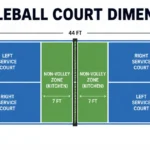
The court footprint is identical — both are 44 × 20 feet. But the net height is completely different. A badminton net at 5 feet is significantly taller than a pickleball net at 34 inches. The court lines are also different — pickleball has a 7-foot non-volley zone (kitchen), while badminton uses service lines at 6.5 feet from the net.
Badminton Court Surfaces
Surface choice directly affects shuttle flight, player speed, and joint safety — particularly in a game where lateral movement is constant and explosive.
Wooden flooring (hardwood / sprung maple) is the BWF-approved standard for international competition. It provides consistent shuttle bounce off the floor, reliable traction, and the best shock absorption for high-intensity movement.
Synthetic / PVC court mats are widely used in club and recreational settings. They install over concrete or tile, provide better cushioning than bare hard floors, and offer consistent non-slip grip. BWF-approved synthetic mats must meet minimum anti-slip and shock absorption standards.
Concrete and asphalt are viable for outdoor recreational play only. They’re durable and low-maintenance but provide no shock absorption — significantly increasing stress on ankles, knees, and hips during competitive play.
Grass is occasionally used for casual backyard badminton but is not suitable for any competitive format. Uneven surface and variable shuttle response make consistent play impossible.
Hi, I’m Aria Blake, the author at FramesSize.com. I help make measurements simple with clear guides, easy explanations, and practical size comparisons. Explore our content to understand dimensions, frame sizes, lengths, and everyday measurements quickly and confidently.